

Key takeaways
- Both landlords and tenants must give at least 60 days' written notice before lease expiry for non-renewal.
- A landlord can choose not to renew without stating a reason, as long as the 60-day notice is served correctly.
- Mid-lease evictions require a valid legal ground — non-payment, misuse, subletting without permission or property damage.
- Self-help evictions (changing locks, cutting utilities) are illegal and can result in penalties against the landlord.
- All tenancy contracts must be registered via Tawtheeq to be enforceable at RDSC.
- Disputes go to the Rent Dispute Settlement Committee (RDSC) under the Abu Dhabi Judicial Department (ADJD).
What notice period applies in Abu Dhabi?
The standard notice period for non-renewal or eviction is 60 days before lease expiry. This applies to both parties. Either side that wants to end the tenancy must send a written notice at least two months in advance.
This differs from Dubai, where landlords need 12 months' notice for end-of-lease evictions. In Abu Dhabi, a landlord can simply choose not to renew — no reason required. The 60-day window is all that matters.
Valid grounds for mid-lease eviction

A landlord cannot remove a tenant mid-lease without a legal reason. Law No. 20 of 2006 lists the specific grounds that qualify:
- Non-payment of rent — the tenant fails to pay after a grace period. Paying all dues before a final ruling can stop the case, but only once.
- Unauthorised subletting — renting out part or all of the property without the landlord's written permission.
- Overcrowding — the number of occupants exceeds the accepted limits for the unit.
- Misuse of property — using it for purposes not agreed in the contract, or in ways that harm the landlord's interests.
- Public nuisance — disturbing neighbours or acting against public morals.
- Demolition or major renovation — the building must be at least 15 years old for demolition-related evictions, and strict conditions apply.
- Personal use by the owner — if a landlord takes back the property for personal use, then re-lets it to someone else, the original tenant can claim compensation of up to one year's rent.
For landlord-initiated reasons like personal use or planned sale, 12 months' notice is required in practice, with supporting documentation. Similar notice obligations apply under the Abu Dhabi rent increase law — both cap what a landlord can demand unilaterally.
How to issue a valid eviction notice in Abu Dhabi
The notice must be in writing. A WhatsApp message or informal email will not hold up at RDSC. It should be notarised or sent via a registered channel that creates a delivery record.
The notice must include names of both parties, the property address, the legal basis for eviction (for mid-lease cases) and the date the tenant must vacate. Before sending, confirm the tenancy contract is registered through Tawtheeq. Without that registration, enforcing the notice through official channels becomes much harder.
What landlords cannot do
A landlord in Abu Dhabi cannot evict a tenant by force. Changing locks, cutting water or electricity, or removing furniture is illegal. It can result in penalties against the landlord — not the tenant.
If a tenant refuses to leave after a valid notice, the correct route is to file with RDSC. Let the system handle enforcement.
The RDSC process: step by step
If the tenant does not vacate after a valid notice, the landlord files with the RDSC under ADJD. Here's how it works:
- File a case. Submit the attested tenancy contract, title deed or proof of ownership, ID copies for both parties and proof of notice delivery.
- Conciliation stage. RDSC starts with mediation. Many disputes settle here without a formal hearing.
- Hearing and judgment. If mediation fails, a panel issues a binding ruling.
- Enforcement. Once the judgment is final, the Execution Department carries it out — with police assistance if needed. Tenants may receive a short grace period before physical enforcement begins.
To initiate the process or access forms, use the Tamm portal or call ADJD on 800 2353.
Tenant rights: what a valid notice looks like
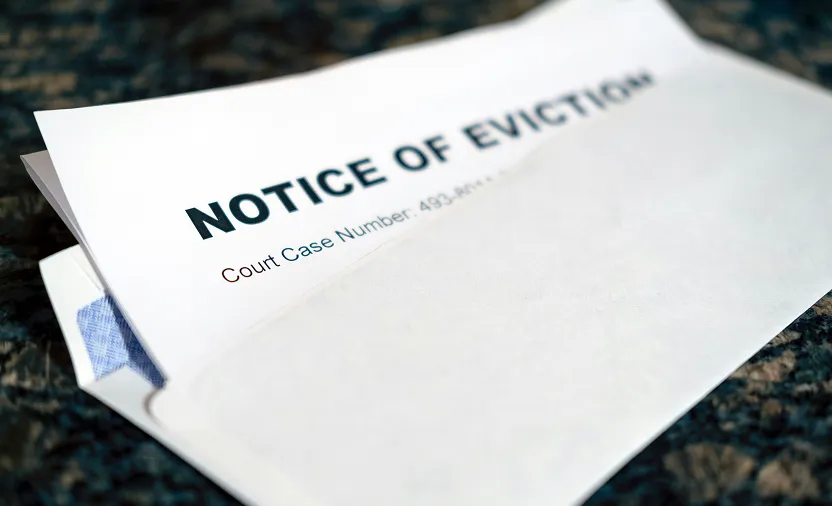
A tenant in Abu Dhabi cannot be evicted without proper written notice and an RDSC order. If you receive a notice, check two things: was it delivered in writing through a verifiable channel, and was it sent at least 60 days before lease expiry?
If it does not meet these conditions, you have grounds to challenge it at RDSC. Bring all documentation — your registered contract, payment records and any written communications with the landlord.
Paying rent on time is the clearest protection available. Non-payment is the most common eviction ground under Abu Dhabi law. As noted under Abu Dhabi rental laws, tenants can sometimes stop proceedings by settling all dues before a final ruling — but only once.
FAQs
Can a landlord evict a tenant in Abu Dhabi without giving a reason?
At the end of a lease term, yes. A landlord does not have to state a reason for choosing not to renew. They must send a written notice at least 60 days before the lease expires. Mid-lease evictions are different — a valid legal ground listed under Law No. 20 of 2006 is required.
What happens if a tenant refuses to leave after an eviction notice in Abu Dhabi?
The landlord must file a case with RDSC. If the ruling favours eviction, the Execution Department under ADJD enforces the order. Landlords cannot forcibly remove a tenant or cut utilities — doing so is illegal and leads to penalties against the landlord.
How long does the RDSC eviction process take in Abu Dhabi?
Cases that reach conciliation often settle within a few weeks. A full hearing typically takes one to three months, depending on complexity and whether either party appeals. RDSC decisions are generally final for smaller claims, with appeal rights available for higher-value cases.
Abu Dhabi's eviction rules give landlords more flexibility than Dubai on non-renewal — no stated reason needed, just 60 days' notice. But the moment a landlord tries to skip legal channels, the process turns against them quickly. Keeping contracts on Tawtheeq, notices in writing and disputes inside official channels is the only way to navigate this reliably — for either side.