



TL;DR – Key Takeaways
- Short-term rentals (up to 6 months) suit tourists, business travellers, and newly arrived expats. Long-term (12 months) suits residents, families, and anyone wanting stability.
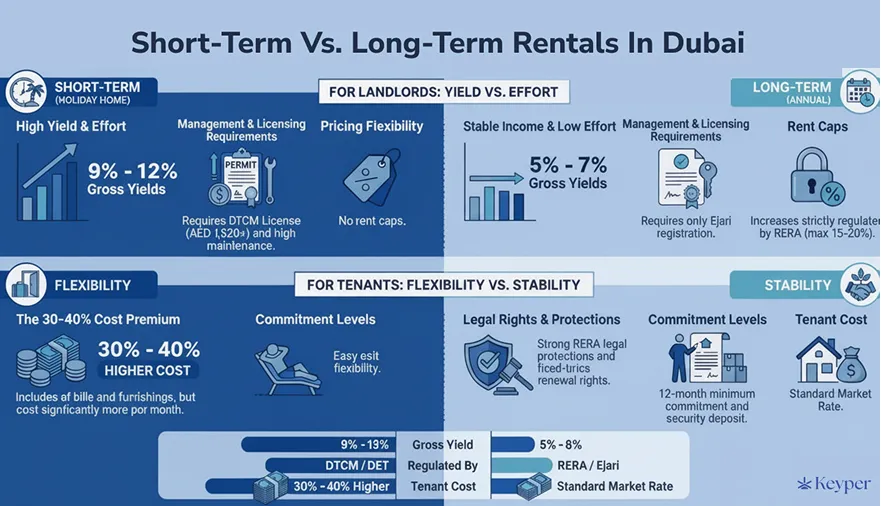
- Landlords can earn higher yields on short-term — up to 9% gross — but face more management, licensing costs, and seasonal vacancies.
- Long-term gives landlords predictable income with minimal effort, but RERA caps annual rent increases at 15% or less.
- Short-term tenants pay 30–40% more per month. Long-term tenants get lower rents and strong legal protections under RERA.
- Short-term landlords must obtain a DTCM/DET Holiday Home License (AED 1,520 registration, annual renewal).
-
Landlords: Higher Yields vs. Less Hassle
For landlords, the core trade-off is straightforward: short-term rentals offer the potential for higher income but require significantly more work. Long-term rentals are lower-maintenance, but your upside is capped.
The case for short-term rentals
If your property sits in a high-demand tourist area, such as Dubai Marina, Downtown, or Palm Jumeirah, short-term rentals can generate more income than a standard annual tenancy. With no rent caps and the ability to price dynamically during peak seasons, gross yields of up to 9% are achievable.
You also retain the flexibility to block off the property for personal use — something long-term tenants make impossible.
Important: Short-term rentals require a DTCM/DET Holiday Home License, AED 1,520 to register, with annual renewal required. Each license covers up to 8 properties. Operating without one can result in fines.
The downsides are real. You're responsible for guest management, cleaning, and turnover between stays. Low-season vacancies eat into your yields, and non-compliance with DTCM regulations carries penalties.
The case for long-term rentals

A signed 12-month lease means predictable income and far fewer management headaches. Registering via Ejari is straightforward, disputes are governed by a clear legal framework, and tenant turnover is minimal.
The main limitation: RERA caps annual rent increases at 20% or less (Depending on the Smart Rental Index). In a fast-moving market, this can slow your ability to bring rents up to current rates.
| Aspect | Short-Term | Long-Term |
|---|---|---|
| Income | Higher potential, variable by season | Predictable, stable monthly income |
| Management | High — guests, cleaning, turnover | Low ongoing effort |
| Regulations | DTCM license (AED 1,520+ annually) | Ejari registration only |
| Risks | Seasonality, compliance fines, wear & tear | Rent disputes, capped increases |
| Yield Potential | 9 to 12% gross in prime areas | Steady 5–7%, lower variance |
Tenants: Flexibility vs. Stability
For tenants, the decision reflects where you are in life. If you're new to Dubai, on a short contract, or still figuring out which area suits you, short-term flexibility makes sense. If you've settled, have a family, or want to put down roots somewhere, long-term renting in Dubai is almost always the better financial and practical choice.
Short-term: freedom at a premium
.jpg)
Short-term units are fully furnished, with utilities and internet included. You can move in immediately and leave when plans change — no long-term commitment required. That makes them genuinely useful for expats testing Dubai or anyone on a project-based assignment.
The catch: you'll pay a significant premium. Short-term rentals typically cost 30–40% more per month than equivalent long-term options. And there's no guarantee of renewal; You could find yourself searching for a new place at short notice.
Long-term: lower costs, stronger rights

Tenants on 12-month leases benefit from RERA's tenancy laws in Dubai — fixed pricing during the tenancy, clear renewal rights, and a security deposit that is refunded at the end of the lease. Monthly costs are substantially lower, and the stability of knowing your tenancy is protected matters when you're trying to settle into a community.
The trade-offs: upfront financial commitment (security deposit plus potentially multiple cheques at signing), less flexibility to relocate quickly, and furnishings that often need to be sourced separately.
| Aspect | Short-Term | Long-Term |
|---|---|---|
| Monthly Cost | Higher bills typically included | 30–40% lower on average |
| Flexibility | High — easy exit, no long commitment | Low — 12-month minimum |
| Furnishings | Fully furnished, move-in ready | Varies |
| Legal Protection | Limited, host-dependent terms | Strong RERA protections |
| Stability | Temporary by nature | More stability with contract renewals |
FAQs
1. Can a landlord switch from long-term to short-term rental?
Yes, but only once an existing long-term tenancy contract has ended. You'll also need to obtain a DTCM/DET Holiday Home License before listing the property as a short-term rental. Switching without the license can result in fines.
2. Are short-term rentals legal in Dubai?
Yes — short-term rentals are legal in Dubai, provided the landlord holds a valid DTCM/DET Holiday Home License. Listing on platforms like Airbnb without this license is not permitted and can lead to penalties.
3. How much can a landlord increase rent each year?
Under RERA regulations, annual rent increases for long-term tenancies are capped at a maximum of 15%. The actual allowable increase depends on the RERA Rental Index. In many cases, the permitted increase is lower than 15% or even zero.
4. As a tenant, is short-term always more expensive?
Yes, they cost 30–40% more than a comparable long-term unit. However, short-term usually includes bills, furnishings, and internet, which would be additional costs under most long-term arrangements. For stays under 2–3 months, short-term can work out comparable in total cost.
Short-term and long-term renting in Dubai are different choices. And the right choice comes down to personal preferences. Also, if you are a landlord, you can explore high-ROI areas in Dubai to generate more rental yield. On the other hand, tenants can look for the ideal neighbourhood in Dubai according to their lifestyle.
This article is for general informational purposes only and does not constitute legal advice. For specific cases and the latest regulations, consult a qualified legal professional.



.jpg)
.jpg)